
‘What you say matters’ in nursing simulation
Published on Feb 27, 2026
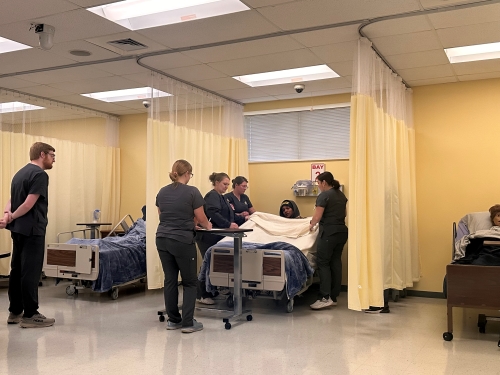 First-year associate degree nursing (ADN) students on the Licking Valley Campus of
Maysville Community and Technical College recently had the opportunity to test their
patient and bedside manner skills in a simulation using a standardized patient, otherwise
known as a simulation actor.
First-year associate degree nursing (ADN) students on the Licking Valley Campus of
Maysville Community and Technical College recently had the opportunity to test their
patient and bedside manner skills in a simulation using a standardized patient, otherwise
known as a simulation actor.
“Because mental illness and suicide are so prevalent today, I wanted to really challenge the students to apply therapeutic communication, demonstrate compassion, and prioritize safety,” Lauren Blanton, MCTC nursing instructor, said. “These skills are vital in nursing, because no matter the facility or unit, they will likely encounter situations similar to the ones we simulated.”
In order to make the simulation feel as realistic as possible, Blanton worked closely with Melinda Walker, a psychology professor at MCTC, and a police officer in Cynthiana.
Additionally, the simulated patient was portrayed by a friend of one of Blanton’s nursing colleagues, Hillary Poe.
“I was so grateful for the level of collaboration and generosity from everyone involved. It truly made the experience so special,” she said. “Using a standardized patient actor for our behavioral health simulation, these ADN students saw firsthand that what you say can matter more than what you do.”
Kendra Fizette, the class president for the first-year ADN students on campus, remarked on the significance of the actor-based simulation.
"Nursing is a challenging field to be in, and the more hands-on experiences you get, the more it will help you in the long run. Being able to have simulations that pertain to each unit in the nursing program aids in our learning by challenging our brains to see what we've learned, how to handle situations in the moment, utilize our critical thinking skills, and work as a team,” she said.
Fizette noted that clinicals offer great hands-on experiences as well, but simulations are more in a controlled environment and allow the circumstances to feel more realistic.
“Each group comes into the scenario not knowing what is going to happen. During the scenario, we are given roles and have to work as a team for the benefit of the patient. The simulation itself is a great tool that I am so glad we are utilizing. I really feel as if the simulations are aiding in my and my fellow classmates' education,” she continued.
Raele Barnett and Makenna Dennie, students in the first-year ADN class, shared Fizette’s sentiments, adding that they felt they had the opportunity to use more skills than usual.
"I really like how hands-on it is, especially this last simulation for mental health, where there was an actual person as opposed to a mannequin. You're able to use your knowledge in a situation that you wouldn't get to on a computer,” Barnett said.
Blanton added that students told her after the simulation that it helped to “click” everything they’ve been learning into place.
“This simulation is a great learning experience that allows us to ask questions and discuss afterwards about what was good and what had room for improvement. This helps us learn and grow from mistakes that may have been made! It is not to criticize us, but instead to introduce us to real-life scenarios we may see when working in healthcare and help us grow as nurses to be,” said Dennie.
For more information on the nursing program at MCTC, go to maysville.kctcs.edu.
